
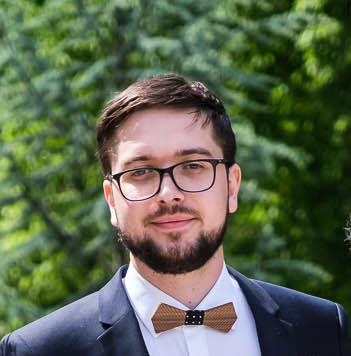
SIMON VEDL is a PhD candidate in theoretical physics at Macquarie University, supported by a Sydney Quantum Academy PhD Scholarship. Originally from the Czech Republic, Simon uses advanced mathematical tools, including wavelets and functional transforms, to explore how quantum fields behave when their resolution is limited. 

His research spans the Casimir effect to gauge theory and aims to answer deep questions about the structure of spacetime and matter. We spoke to Simon about his journey into quantum science, what fuels his curiosity, and his advice for future PhD students. 

What first sparked your interest in maths and quantum physics? 

Simon explores the fundamentals of heat transfer during one of his first high school physics experiments.

My interest in maths came first, before physics. In Year 5, I did my first Math Olympiad and found that it tickled my brain in a really nice way. The problems were different from anything we did in class, and what mattered wasn’t just the answer, but how you got there.  

In school, a lot of people develop a misunderstanding of what maths is. It’s not about calculating the angles in a triangle, it’s about understanding why they always add up to 180º. That deeper reasoning is what pulled me in. 

My interest in quantum physics came later during my undergraduate studies. I was drawn in by these weird new machines called quantum computers and as I dug into how they worked, I realised I was far more fascinated by the underlying quantum mechanics than the computers themselves. 

What is your PhD research about? 

My research broadly falls under the umbrella of relativistic quantum information science. Quantum information science studies how information is stored, processed, scrambled, recovered, or distributed in quantum systems under quantum mechanical processes. The word “relativistic” means that we try to apply the techniques from quantum information to study the nature of spacetime and the building blocks of matter, the fundamental particle fields.  

Simon Vedl, PhD candidate in theoretical physics, Macquarie University, supported by a Sydney Quantum Academy PhD Scholarship

Imagine the states of these particle fields as a kind of signal.  We use a mathematical tool called the wavelet transform to process that signal and explore what happens when you introduce a resolution limit. 

 We obtain a representation of these states that captures the fact that all physical observations come with a limited resolution. This helps us model how quantum fields behave because in the real world, nothing can be measured or observed with perfect sharpness. 

What mathematical tools do you work with? 

I use two main tools: the Fourier transform, and the wavelet transform- both from signal processing.  

The easiest way to understand them is to use a musical analogy. When you record a song, you store it as a function of time, so you can rewind or skip ahead. If you feed that recording into the Fourier transform, it tells you which notes are present, and how often they occur. But it does not tell you when they occur.  

The wavelet transform fills that gap. It tells you which notes appear and when – like the music sheet for the recording. That’s what makes these tools useful for studying quantum fields, which evolve in space and time. 

How does maths help you make sense of quantum theories?

Classical physics, like Newton’s laws of motion, laws of thermodynamics, or electromagnetism, are built on our everyday experiences and interactions with the natural world. You feel a force pushing you, you feel heat, you get zapped by electricity. Calculus and differential equations were invented to reflect our physical intuition based on our lived experience. In that sense, physics came first, then the maths.  

Quantum physics does not follow this pattern. We don’t experience the quantum world directly. It’s not intuitive.  

Take Schrödinger’s cat, how can it be both dead and alive? There is no universally accepted explanation. In quantum physics, the maths is the explanation- it’s the only thing that works.  Maths becomes the lens we use to understand a world we can’t see or feel. 

What’s one surprising insight you’ve come across? 

This didn’t come directly from my research, but it is related. In high school, physics was presented to me as this very precise, dogmatic science- like we had everything figured out and had perfect mathematical formulas to explain it all. 

But once I got to university (and especially in my PhD) I realised that the nature of physics is something else entirely. It’s about getting comfortable with imperfections and precisely accounting for them in our experiments.  

The world does not follow a perfect mathematical formula, but I am always astounded that despite how chaotic the world can be, our equations still get surprisingly close. 

What does a typical day, or week look like for you? 

My week looks like most office workers. I try to keep a clear boundary between work and personal time even though good ideas do sometimes strike in the shower! I just write them down and revisit them when I’m back at my desk.  

Most days, I’m either at the whiteboard solving problems by hand or convincing my computer to solve the ones I can’t. Then I document what I’ve found and some days I teach as well.  

After work, I have dinner with my partner, and we debrief about our days. Then we might watch something, or I’ll play video games. On weekends, I like hiking or going to the beach when the weather’s good. 

Why did you choose to do your PhD in Sydney — and what’s it been like doing it at Macquarie University? 

Moving to the other side of the world sounded like a great adventure — and my partner was keen to come too. 

Macquarie really impressed me from day one.  The campus is modern, well-equipped, and full of green space — it creates a great environment for thinking and working. The faculty and staff are welcoming and supportive, and the student community is active, diverse, and inclusive. 

What’s been the most valuable part of being in the SQA community? 

PhDs can be stressful, but having a big community of people that are going through the same thing is really helpful. I’ve made great friends in the SQA community, and I love the events where we can get together and find out what everyone is doing.

Every SQA event is like a mini conference. We learn from invited speakers and share our experiences and tips and tricks for doing certain things over snacks and drinks.  I never felt that I was just on my own. I feel truly connected to the Sydney/Australian quantum ecosystem. 

What advice would you give to students considering a PhD in quantum? 

Quantum is a fantastic field with lots of opportunities — but it’s important to be honest with yourself about why you want to do a PhD. It’s not always sunshine and rainbows, and it can be tough.  If you’re doing it for the right reasons, that motivation will carry you through the hard parts.  

Once you’ve done that internal check, do your research on the group you want to join. Reach out to current and former students. A PhD is basically a full-time job — and your supervisor is your boss. You want to make sure they’re the right fit. 

What would you say to students who love maths or physics but aren’t sure where it could take them? 

Do what you love right now. I grew up in a small town and had no idea what career options a maths or physics degree could lead to. I had a vague idea about working at a bank with a maths degree, or a nuclear power plant near my hometown. 

I started a degree in nuclear engineering but within two months I realised it wasn’t for me. I had the mental capacity, but I was not that passionate about the subject. I switched to theoretical physics because it challenged me in the same way the Math Olympiad problems did in Year 5.  

I also noticed how many jobs are out there for maths/physics graduates. Companies value the skills we bring like critical thinking, analytical reasoning, and the ability to research, understand, and learn complex topics. They want smart, capable people and maths/physics graduates from good universities usually are.

Find out more about our PhD scholarship programs. Or search our database of more than 100 quantum experts working on quantum technologies in Sydney who are available to supervise PhD students.


Don't miss quantum news! To stay updated on quantum news and events, sign up to our mailing list.

Begin your quantum PhD journey in Sydney today

Sydney is one of the few places in the world where theory, experiment, and industry come together at scale. And we need minds that are curious, rigorous, and ambitious enough to take quantum from possibility to reality.

If that sounds like you, then this is where your journey begins.