Varun Srivastava first heard of quantum mechanics back in high school, when he borrowed a book about Einstein’s discoveries. 

Varun is a PhD candidate at Macquarie University, supported by an SQA PhD Scholarship.

“It all sounded very mysterious and interesting – atomic particles tunnelling through barriers like ghosts and being in two places at once!” 

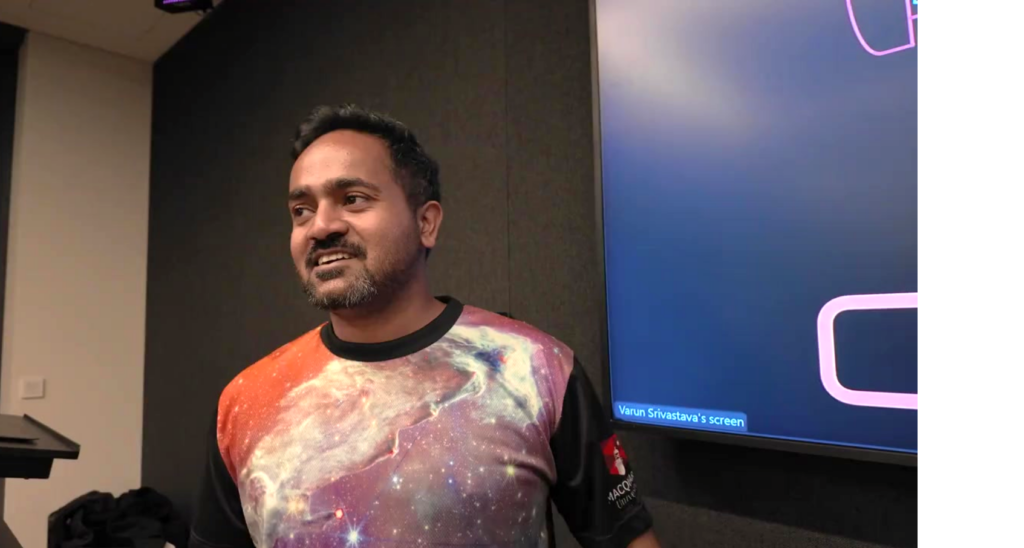
Little did he know that a decade later, he’d be teaching the very same intriguing concepts to high school students in some of the most remote areas in the world as part of his PhD at Macquarie University, with the support of an SQA PhD Scholarship

“On this ARC Centre of Excellence for Engineered Quantum Systems (EQUS) road trip we visited multiple schools in very remote towns, even travelling 200 kms into the bush in the middle of nowhere,” he said. 

“It was a very unique experience interacting with them and seeing their excitement and they asked brilliant questions.” 

The unexpected adventure is just one standout memory from Varun’s PhD journey to date, where he’s also travelled on a two-month research tour in Stockholm, Sweden and built a strong global network of connections with emerging quantum researchers through fellow students in SQA’s PhD Experience Program

“I have made many good friends and talked to many interesting people during SQA student events and learned a lot,” he said. 

“Apart from academics, SQA has provided a lot of opportunities for science communication events which I am always interested to be a part of.” 

Achieving greater precision in quantum devices 

Under the supervision of Associate Professor Alexei Gilchrist, Varun’s PhD research is developing new mathematical tools to develop frameworks for understanding the errors that occur in ‘qubits’ – quantum computing’s equivalent of ‘bits’ in classical computing.   

Qubits follow the “strange rules” of quantum mechanics, which mean they can behave as not only the 0s and 1s of today’s computers, but also as both 0s and 1s simultaneously. It’s this extraordinary characteristic that gives quantum computers enormous power and the potential to solve extremely complex problems.  

But to realise this full potential, quantum computers must first overcome a fundamental challenge: the fragility of qubits themselves, which can interact with surrounding qubits in a way that introduces operating errors. Qubits can even sometimes hold a ‘memory’ of these errors that further complicate future computations. 

Through SQA's PhD Experience Program, Varun has engaged in science outreach, including sharing his research with the wider SQA PhD community.

“One way to picture this is to imagine a bunch of tiny magnets arranged next to each other,” Varun explained. 

“If I try to move just one magnet, the magnets around it might move slightly as well, because they interact with each other. Something similar can happen with qubits: when we try to control one, we can accidentally affect its neighbours. 

“My research is essentially about building mathematical models that help us understand these complicated errors in a systematic way.”  

By creating benchmarks and characterising quantum processes using mathematical models, Varun’s work is helping scientists create a more reliable way to test and compare how quantum devices work, particularly by understanding where errors occur.  

“In the long run, this could help us build more accurate, reliable and scalable devices,” said Varun.  

Joining a vibrant quantum hub 

Meeting fellow quantum students from across SQA's four partner universities has been a highlight of Varun's PhD journey so far.

Drawn to Sydney and SQA’s program by its active student community, extensive industry links and the cross-institutional coursework opportunities on offer across SQA’s four partner universities, Varun said the chance to live in “one of most beautiful places to live” was definitely an additional motivator. 

Along the way, he’s made friendships and learned from his peers across the full spectrum of quantum fields, particularly during his time on the SQA student committee, where he helped to organise networking and career development events. 

As he approaches the end of his PhD, Varun is grateful for new perspectives he’s gained on his future career direction thanks to SQA’s networks across the growing quantum ecosystem in Sydney.  

“I’m now considering industry positions, not just academic ones – and being part of SQA has helped me build connections which I can reach out to now,” he said.   

Prepared for many paths ahead 

Regardless of his next step, Varun remains excited that his work is contributing to the “paradigm shift” that quantum technologies represent in our computational capabilities. 

“A PhD is not all sunshine and roses – sometimes it gets frustrating and requires hard work sitting with a problem for a long time before you hit a solution,” he reflected. 

“But it’s also that hard work that makes those ‘aha!’ moments so satisfying.” 

Find out more about our PhD scholarship programs. Or search our database of more than 100 quantum experts working on quantum technologies in Sydney who are available to supervise PhD students.